When I moved I brought my degrees, my work history, and fifteen years of knowing how to walk into a room. None of it meant anything to anyone who had not been in the room with me.
The people who knew without being asked that I was competent, that I was funny, that I was the one you called when something needed to get done, were suddenly on the wrong continent. And the people around me had no version of me to work with at all.
And let us be honest, most of us only find that out once we are already here.
That is where Renata Takacura's work starts.
Renata is a global career consultant and one of the specialists who contributed to Parenting Unpacked. She works with professionals navigating career transitions across countries and cultures. And she is the one who introduced me to the concept of social mirrors.
What Are Social Mirrors? How Migration Cracks the Reflection of Your Competence
"Our identity is built socially. From the moment we are born, we understand who we are in relation to other people. We become someone's child, sibling, grandchild. As we grow up we are told we are easygoing, shy, outgoing, responsible. Those messages become some of our first social mirrors. Later we build friendships, join communities, and develop a sense of belonging with people who share our interests and values. Throughout life our sense of self is continuously shaped and reshaped through these relationships. That is why social mirrors matter. They do not just influence how others see us. They also influence how we see ourselves. While self-confidence is important, our identity is never formed in isolation. It develops through the feedback, recognition, and relationships we experience with others."
I kept thinking about the specific people who had been holding that mirror for me without either of us realising it.

This is Renata Takacura.
What Happens to Professional Identity Abroad When the Mirrors Disappear?
"Professional identity, like personal identity, is largely shaped through our social relationships. We develop a sense of competence and value because it is recognised and reinforced by the culture around us. When someone moves to a new country, many of those familiar mirrors disappear. Degrees, professional titles, and work experience that were highly valued in one culture may not be recognised in another. This is especially common for professionals moving from the Global South to the Global North, where foreign qualifications and experience are usually undervalued. Speaking with an accent may lead others to make unfair assumptions about competence. When this happens, a person's sense of professional identity and self-worth is shaken. That is why it is so important to have a clear understanding of your own strengths and transferable skills, to explore different career pathways, and to be realistic about where you are willing or not to compromise."
That structural observation is what the inherited scorecard misses entirely. It tells you to work harder without telling you that the system reading your work may have already decided what it is worth.
Can You Rebuild Your Identity Abroad Without Losing Who You Are?
"Human beings are remarkably resilient. Throughout our lives we are constantly reshaping our identity based on our experiences. Major life transitions such as graduating, becoming a parent, changing careers, or moving abroad lead us to review and redefine parts of who we are. I do not believe we have to become someone different to be seen. Instead we need to find spaces where our strengths, values, and experiences are recognised and appreciated. We may learn new ways of approaching and communicating, or develop new skills, but that is different from changing who we are. The key is not to reinvent yourself to fit the new culture but to build new social mirrors that reflect your authentic value."
It starts smaller than you think. One person who gets it. One room where you do not have to prove the version of you that used to be obvious.
Chapter 16 of Parenting Unpacked goes into what replaces the work that used to define you and what identity actually looks like when you are building new mirrors from scratch. 💛
Jessica Gabrielzyk
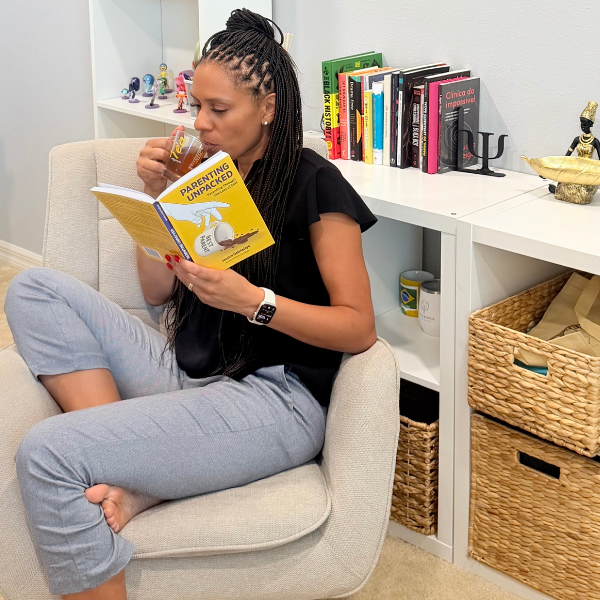
Intercultural Psychologist Margery Pimentel is the official book model. LOVE IT.