A while back during a SIETAR conversation, intercultural psychologist Margery Pimentel said something along the lines of immigrants are minorities. She probably said it in a more measured way but that is the note I had on a piece of paper: immigrants are minorities, write about it. And guess what? It is time to talk about it.
I remember she got a gasp out of me with that comment. I get why she got that reaction out of me, honestly. But let me explain better.
Minority is a word that carries a lot of weight in some contexts and almost none in others. If you grew up in a place where you belonged to the dominant group, the word probably never applied to you. It was something that happened to other people. Something you observed from the outside.
And when I moved countries I genuinely do not think I felt much of a difference. Yes, I had some lip twirl moments that I have discussed here before [Click Here to read it] but honestly I never felt discriminated against. Okay, maybe I did not always know how to distinguish if someone mistreated me for being an immigrant, but I never felt it.
I am white. I grew up in Brazil where being white did not make me a racial minority. I understood the concept of minority intellectually before I understood it personally. And even living abroad I would not claim to have felt the full weight of what minority status costs someone who carries it in their skin every single day.
I think the blue eyes probably made people read me as the rich person, which I was not.
When I moved to Australia with a weird surname but a well used western name and skin as pale as a piece of paper and blue eyes, if I kept my mouth shut I was just another one.
So much so that I remember standing on a platform in Nundah waiting for a train when I saw two people being nasty toward an Asian kid. Not violent but saying bad things. I was approaching and honestly did not have enough English at the time to understand everything being said but I could read the room. I saw how sad he looked. The boy ignored them and walked away. The two turned toward me and asked which side to take the train to the CBD. Without saying a word I pointed and with a wide smile they thanked me and left. Like I was one of them.
I ended up on the same side of the train as the boy. I asked if he was fine and he said yes.
It was a small glimpse of what Margery was making me notice: how quickly the social position you take for granted can change when the room changes.
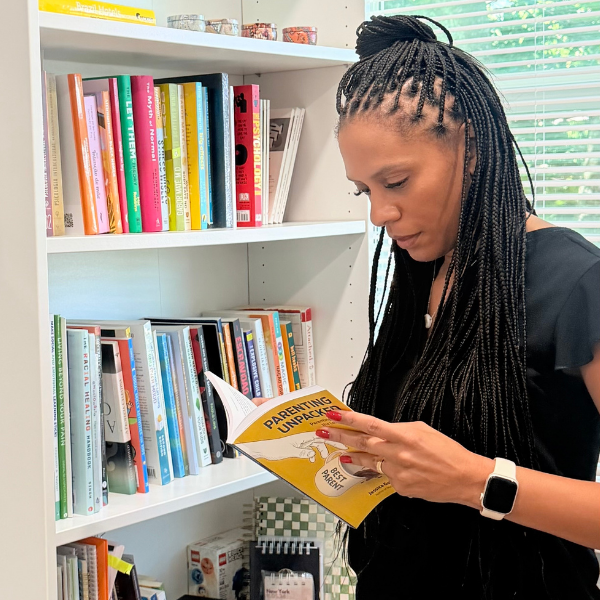
Margery Pimentel reading Parenting Unpacked. She is an intercultural psychologist whose work on racial identity, migration, and what loneliness after moving really costs a parent shaped chapters of this book. Seeing her with it in her hands is everything. 💛
The Brazilian Woman and Her Daughter
I heard a Brazilian white woman venting recently about the prejudice she experiences in Brazil for being older. She named it clearly, the way it feels to be dismissed, overlooked, made smaller by assumptions about what age means.
What struck me was not the prejudice itself. It was the specificity of her surprise at experiencing it. Because prejudice directed at her, a white woman in Brazil, for something as visible and unchosen as age, seemed to be new territory for her.
And then I thought about her daughter.
Her daughter lives abroad. She is white too. And by the logic of the conversation her mother was having, whiteness should protect her from that particular kind of otherness.
But her daughter may experience minority status abroad. The reason has less to do with her skin than with her passport, her accent, her name, her references, her way of reading a room that does not match the room she is standing in. Because minority status is not simply a fixed property of a person. It is relational, shaped by the context, the room, the country, and the system doing the categorising.
Listening to her, I wondered whether that understanding had extended to her daughter, who may be experiencing some of the same dynamics somewhere else, in a different country and in a different form.
That gap between the identity your family knows and the identity the new country assigns you is one of the things Parenting Unpacked was written to name. If you have ever arrived somewhere carrying a version of yourself that nobody in the room could see yet, the book is where that experience gets language.
The first forty pages are free and you do not need an email address to read them. Start here. 💛
What Margery's Observation Actually Names
When Margery said that immigrants are minorities, I understood her to be talking about social position rather than statistics.
The shock can come from the gap between the identity a person carries from home and the identity the new country assigns them. You arrive as a professional, a parent, a competent adult with a history and a reputation and a way of being in the world, and the new country reads you as foreign first. Everything else comes after that, if it comes at all.
That reassignment is one way minority status can be experienced in practice by an immigrant, not simply a legal category or demographic label but a shift in social position: being placed in a group you did not choose, defined by characteristics you cannot change, in a context where those characteristics carry a meaning you did not bring with you.
I suspect that is why the idea can be so surprising to people who move countries. They do not necessarily think of themselves as minorities before they move and only begin to understand that dimension of their identity after they arrive.
This is one of the points I explored in Parenting Unpacked with Margery Pimentel's contribution shaping how I understood it. Her clinical work with immigrants and minorities gave me the language for something I had been living without knowing what to call it.
The first forty pages are free and you do not need an email address to read them. Start here. 💛
Jessica Gabrielzyk