Two things can be true when you live in another language.
One: you can feel a lot dumber when you are still getting a grip on a new language.
Not actually dumber, just temporarily robbed of your personality and roughly 40% of your brain.You know what you want to say. You have a perfectly reasonable thought. Perhaps even a brilliant one. And then your brain goes:
Do we know the word for that?
No.
Can we explain it another way?
Also no.
Can we just nod?
Excellent. Let's nod.
You don't have the vocabulary yet to argue properly. You can't make the joke you would normally make. You know exactly what you mean, but somehow you sound like a five-year-old who has just discovered verbs.
Two: you can become extremely fluent.
You can discuss politics, religion, relationships, capitalism, the housing market, the meaning of life, and, I don't know, grout. You can argue. You can joke. You can work. You can flirt. You can explain why someone is completely wrong with impressive grammatical accuracy. And yet. Sometimes you just want to get cosy and talk in your own language. You speak the new one fine. You haven't forgotten a word. You could order coffee in your sleep. You just want to stop. Because as much as you don't have to do the same amount of brain gymnastics you did when you first arrived, you are still doing some. And sometimes you are tired.
Really tired.
So you want the language where you don't have to search for the word. Where the joke arrives before you have translated it. Where you can complain about your day without mentally proofreading the sentence first. Where your personality doesn't need subtitles.
Maybe that's what both things have in common.
At the beginning, the language exhausts you because you can't do enough with it. Later, it exhausts you because you can do almost everything with it. You work hard to get there and when you finally arrive there is still some work involved.
The difference is that now nobody can see it.
Sometimes not even you.
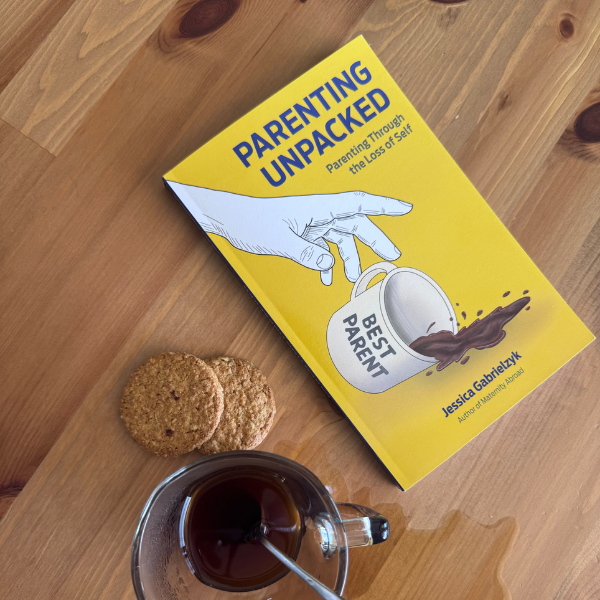
The loss of felt competence is one of the central concepts in Parenting Unpacked. Chapter 13, The Language Gap, is where that experience lives in full. The first forty pages are free. 💛
Jessica Gabrielzyk