Until a few days ago, I was sure the plan was simple: have a great road trip. It has been, and it still is. Then I received an invitation from Papa Balla Ndong, president of SIETAR Valencia and SIETAR Africa, to present my work at the SIETAR Valencia post-congress on Education, Migration and Belonging.
An official invitation to speak about something I care about, and I cannot make it. I am somewhere on a wonderful road trip with barely any internet. Even an invitation from exactly the right person at exactly the right time can lose to geography.
So the talk is coming here instead. The blog gets the presentation, and the Zoom audience gets an unexpected gap in the program. I hope they find something interesting to do with it.
The subject is one I have been thinking about for a long time: what happens to parents after moving abroad, when the boxes are empty, the children are settled, and everyone assumes the difficult part is over? Who decided the parent was fine?
In brief
Moving abroad can become harder after the practical arrangements are finished, when parents lose the everyday evidence that they know what they are doing. I call this a loss of felt competence: having the same abilities and responsibilities while losing the familiar language, routines and social connections that once made those abilities feel natural.
What gets left off the moving checklist
Some mornings, I promised myself I would be the kind of parent who shows up early and brings home warm croissants.At 6:42, I was already outside the bakery with both hands on the stroller bar, my forehead leaving a crescent-shaped smear on the glass. The place did not open until seven. I was eighteen minutes early for a bakery.
The pharmacy went about the same way. The cashier asked how I was, and when I said fine, my voice came out thinner than I expected.
Nothing was actually wrong. Emma was healthy, and our rental apartment in Lausanne had generous afternoon light. It was just that the logistics holding the first weeks together had run out. The forms were filed, the urgent appointments were over, and the boxes were empty.
We tend to treat moving abroad like a project with a clear finish line: unpack the house, sort out the school, open a bank account. Once the list is done, people ask how the children are settling in, which makes sense. Very few ask what happened to the adult who used to buy diapers without thinking about it. I did not ask myself either. I assumed I would just get on with things.
Then one afternoon, the bus pulled up to our stop. The doors opened, other people stepped on, and my feet stayed planted on the pavement. I did not speak French, and the only word I recognized on the display was the name of our stop. I could not work out whether I was supposed to press a button, say something to the driver, or just climb aboard and hope for the best. So I walked forty minutes uphill with Emma in the stroller and called it exercise.
She spent her afternoons strapped into that seat instead of playing at the park, because sore legs felt easier than asking the wrong question.
I was still a capable person living in a place where the small, daily proofs of my competence had stopped working.Eventually, I started calling this a loss of felt competence. You can still run a household, raise a child, and make sensible decisions, yet buying a bus ticket suddenly requires a plan and a backup plan.
The people who reflect us back to ourselves
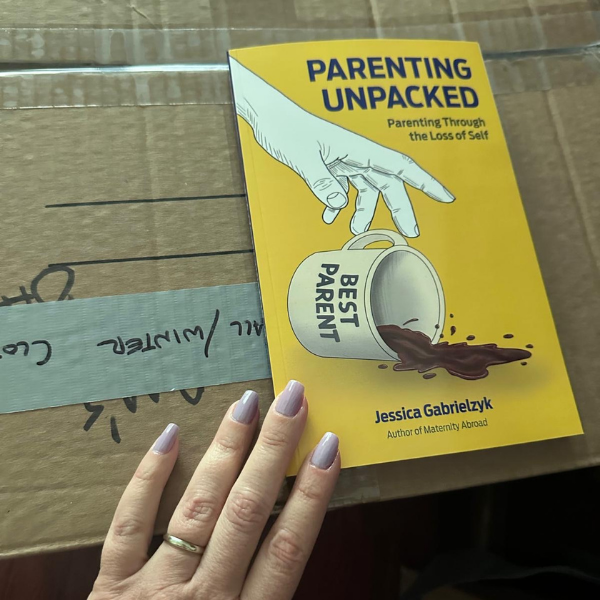
When I started interviewing intercultural psychologists for Parenting Unpacked, Mel Fariña told me that moving abroad belongs in the same category as having a child, getting married or getting divorced. I nodded politely. It sounded a little dramatic and academic. Then I found myself on the floor at midnight beside a bowl of cold popcorn, wondering why I could not get through an ordinary day without feeling useless, and I began to see her point.
Renata Takacura, a global career consultant who works with migrants, uses the term social mirrors for the people and systems that reflect back a recognizable version of who you are. Think of colleagues who know your work, neighbors who recognize your routine and other parents who share their shortcuts. They know what you are good at without needing a PowerPoint. When you move, Renata explains, those mirrors are often among the first things to disappear.
Researchers who study expatriate families have a name for some of the people living through this: the trailing spouse. The phrase is a joke on its own. One person gets the international assignment, and the other gets a job title that sounds like an accessory.
Yvonne McNulty has studied accompanying spouses, and her work shows how relocation can disrupt professional identity and the ability to keep a career going. Her Trailing Spouses Study surveyed 264 accompanying spouses in 54 host countries between 2001 and 2005, and identity emerged as a major finding. According to a summary of her results, 79 percent of the spouses were employed before relocating, compared with 36 percent while accompanying their partners abroad.
Heidi Collins and Santina Bertone followed ten expatriate accompanying spouses through their first year in Sarawak, Malaysia. The men in their sample described threats to their career and worker identities. The women described threats to several identities at once, including mother, wife or partner, child and worker. I keep coming back to that last finding, because it means the loss can reach many of the roles you used to understand yourself through, and the job is only one of them.
Becoming a parent abroad adds a second job to that. You are learning how to be a parent while learning how to function in a place whose rules you do not yet understand. You may have been the person everyone called when something went wrong, and now you are standing in a pharmacy trying to explain what your child needs, wondering whether pointing at the box counts as communication. I have done it. Repeatedly.
Where the research stops
These studies cannot speak for every parent. McNulty and Collins both looked at accompanying spouses, often in families where one partner’s job shaped the move. Ours was different. We left Porto for Lausanne for several reasons, and for the record, the price of salmon ranked high among them. Collins and Bertone also note that their results may not generalize from a sample of ten.
I also noticed that much of the research I read often approached relocation through the traditional expatriate family model: a male employee on an international assignment and a female partner following him. There are studies of male accompanying partners, but fewer, and I suspect fathers raising children abroad get less attention than they should. That may be a limit of my search. It still leaves a question: whose experience of family relocation are we actually studying?
I had assumed identity loss after moving abroad was mostly a career story. It made sense: lose the job, lose the professional identity, lose the recognition that came with it. Mine happened at a bus stop. I was still a mother and a wife, still responsible for remembering approximately seventeen things before leaving the house, and I had lost the ability to do some of the simplest tasks without planning them in advance. I was finding out how much of my identity depended on things I used to do without thinking.
It happens without a move, too
Eventually I noticed the same pattern in people who had not moved anywhere. In conversations for Parenting Unpacked, I heard similar experiences after the arrival of a baby, a new role, a diagnosis or a teenager reaching an age when a parent can no longer follow every decision. In each case the person still had the responsibilities, and the familiar ways of feeling capable had changed. A parent could be running an entire household and have no idea how to answer the question, “So, how are you?”
We are good at spotting practical adjustments. Someone needs to find a school, learn the language, sort out healthcare or get a new job, and we can make lists for all of that. Nobody makes a list for noticing that someone has stopped feeling like themselves. Who is supposed to ask?
Not long ago, I went back to that pharmacy. I felt the same tightening in my chest at the counter, but I ordered what I needed, answered a follow-up question I had not prepared for, and walked out. It was a small interaction. Nobody applauded, and the cashier did not hand me a certificate confirming my successful integration into Swiss society. I noticed anyway.
If you have moved, changed careers or found yourself in a life you did not quite recognize, I would love to know: who asked how you were doing when everyone else assumed you were fine?
Frequently Asked Questions
Why does moving abroad feel hardest after the logistics are done?
The first weeks of a move are full of practical tasks, from finding a home to arranging childcare, and they give you a clear sense of purpose. When those tasks end, the everyday confidence you relied on may not have caught up with your new circumstances. I call this a loss of felt competence.
What is loss of felt competence?
It is the experience of losing the everyday evidence that you know what you are doing. You may have the same abilities, intelligence and responsibilities as before, yet familiar tasks take much more effort because the language, routines and social systems around you have changed.
What are social mirrors?
Global career consultant Renata Takacura uses the term to describe the people and systems that reflect back a recognizable version of who you are. Colleagues, neighbors and other parents can all act as social mirrors. Moving abroad can remove many of these sources of recognition at once.
Do accompanying spouses really lose their sense of identity?
Research suggests that relocation can threaten accompanying spouses' professional and personal identities, especially when it affects employment and career opportunities. The experience can differ between men and women, although small samples and specific expatriate settings limit how widely the findings apply.
Does this only happen to parents who move countries?
No. Similar experiences can follow other major life changes, such as having a baby, changing careers, receiving a diagnosis or watching a child become more independent. Relocation is one situation where the loss of familiar competence becomes easy to see.