You Think You Know Who You Are. Then You Move Countries.
Margery Pimentel is not a new name if you have been following the book or this blog.
She appeared in Parenting Unpacked as one of the specialists whose thinking shaped how I understood what migration does to identity, and in the post about what it means to discover you are a minority in a new country, where something she said at a SIETAR event got a gasp out of me that I have not fully recovered from [its pretty good! Click here to read the post]. She keeps showing up because the questions I keep asking are exactly the ones she spends her working life inside.
But if you are new here, let me tell you about her.
Margery Pimentel is a psychologist trained in Brazil and a Registered Psychotherapist in Canada. Her work sits at the intersection of immigration, intercultural psychology, racial identity and mental health, with particular attention to immigrants and racialized communities. She is also a Black immigrant woman, so her professional work is informed by lived experience as well as clinical practice. She is not describing this territory from the outside.
I sent her three questions. Here is what she said.
Question one: You describe the cost of constantly measuring the new place against the old one as something that settles into the body. How does that chronic comparison show up physically in an exhausted parent, and how do you know when it is no longer just adjustment fatigue?
Margery Pimentel:
Comparison is a natural part of immigration. We use what we already know to understand what is new. So we compare schools, healthcare, the way people communicate, even simple things like going to the grocery store.
But all of that requires extra mental energy. And for an exhausted parent, eventually the body can start responding: trouble sleeping, headaches, muscle tension, irritability, difficulty concentrating, or feeling tired even after resting.
For me, an important question is not just, "How long have you been in this country?" but, "How much effort are you still making every day just to function here?"
Because adaptation is not linear. You can be doing really well at work and still feel completely overwhelmed by parenting, language, healthcare, or not having the support system you used to have.
I start to think beyond adjustment fatigue when the person is no longer recovering. When rest doesn't really restore them and that exhaustion starts affecting different areas of their life. At that point, we need to understand what is keeping that person in a constant state of effort.
I kept thinking about that question after she answered it. Not how long have you been here, but how much effort are you still making every day just to function, because those are completely different questions with completely different answers.
This is the territory Parenting Unpacked addresses directly. The loss of felt competence has a physical dimension that most parenting books never name. Margery helped me understand why.
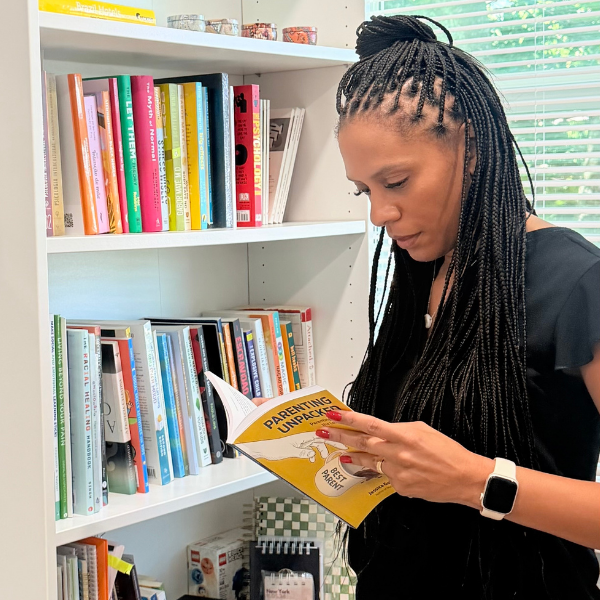
The psychologist who helped me understand what migration does to identity. Holding the book that came from those conversations. 💛
Question two: For parents of color, moving countries often completely reshuffles how race is perceived and experienced. What is the hidden psychological toll of having to relearn your own racial identity while simultaneously trying to anchor your children in a new culture?
Margery Pimentel:
When you move to another country, you don't only learn a new culture. Sometimes you also have to understand who you are in that culture.
Race can be understood very differently depending on where you live. The categories change, the stereotypes change, and even the way people see you can change. So a parent may be trying to understand, "What does it mean to be Black here?" while also helping a child understand what being Black means in this new environment.
As a Black immigrant woman, I think this is something we don't talk about enough. Immigration can make you revisit parts of your identity that you thought were already settled.
And there is another layer when you are a parent. Your child may understand race differently from you because they are growing up inside this new culture. So you are learning the racial codes of the country, trying to understand your own experiences, and at the same time trying to prepare and protect your child.
Sometimes you are trying to give your child answers to questions that you are still figuring out yourself.
I read that sentence twice because it names something that rarely gets said directly in conversations about parenting abroad. You are supposed to have the answers before the questions arrive and not still be working out who you are in this new place while your child is already asking you to explain it.
If this is landing somewhere familiar, the first forty pages of Parenting Unpacked are free and you do not need an email address to read them.
Question three: When an immigrant parent of color takes a sick child to a local doctor, they face a double burden: deciphering an unfamiliar medical system while bracing for the assumption that they will be misunderstood. What does that hypervigilance cost the parent in that moment, and how can they protect their own dignity while advocating for their child?
Margery Pimentel:
When your child is sick, you are already worried. Now imagine dealing with that fear while trying to understand medical language, navigate a healthcare system you don't know, and wondering, "Are they understanding me? Are they taking me seriously?"
For a parent of color, there can be another question in the background: "Is this happening because of my accent? My race? The way I look?"
That hypervigilance takes a lot of energy. You are not only listening to the doctor. You are also reading the room: the tone of voice, facial expressions, whether your questions are being taken seriously, whether you should insist or stay quiet.
And that is exhausting.
I think protecting your dignity starts with remembering that asking questions doesn't make you difficult. Asking someone to repeat something doesn't mean you are incapable. And advocating for your child doesn't require you to prove that you are a "good immigrant."
But I also don't want to put all the responsibility on the parent. Healthcare systems have a responsibility to make sure people can understand and be understood, regardless of their language, race, accent, or cultural background.
Margery Pimentel's point matters for every healthcare professional working with immigrant families: the responsibility for communication cannot sit entirely with the parent.
Margery Pimentel's contribution to Parenting Unpacked is woven through the chapters on identity loss, belonging, and what it costs to parent in a place that did not form you. The book takes her clinical framework and puts it inside the lived experience of the parents who are living it.
The first forty pages are free. 💛
Jessica Gabrielzyk