We Are Pregnant. Are You Sure About That?
I had what was supposed to be a quick video chat with Samar Karam yesterday. We spoke for nearly two hours. Samar is the founder of Cross Culture Consultants, a certified intercultural trainer, a global keynote speaker, and the host of the Culture Capsule Podcast in Abu Dhabi. Seeing her hold up Maternity Abroad, thick with colourful sticky notes, while she quoted my own lines back to me made it an unforgettable conversation.
Then she asked something that caught me off guard: Do you believe in we are pregnant?
I immediately answered no. But the question stayed with me all day. Here is why.
The Phrase That Does Not Exist in Portuguese
The first time I ever encountered the phrase was when Mila Kunis delivered a late night monologue ranting against partners who use it. My immediate reaction matched hers: it made no sense.
In Portuguese, we do not say we are pregnant to mean a couple is expecting. You say estou grávida or ela está grávida. The partner is expecting a baby, esperando um bebê, but he is not pregnant.
That partnership deserves its own language, just not this one.
My husband and I experienced pregnancy together: we worried, planned, attended appointments, and prepared for birth as a unit. But we did not experience it in the same body. There is a fundamental difference between saying this is happening to our family and saying this is happening to both of our bodies. The first is deeply true while the second simply is not.
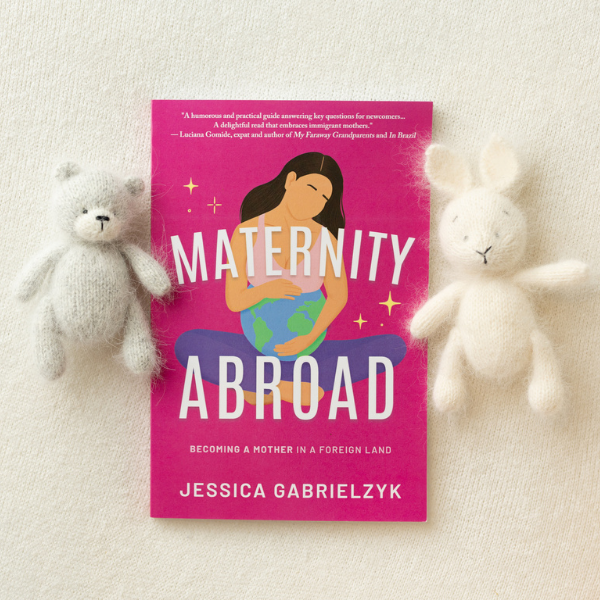
What Maternity Abroad Actually Found
The women I interviewed across five continents for Maternity Abroad were navigating healthcare systems that did not know their norms, their language, or their homes. Their partners were often extraordinary, but they were not the ones lying on the examination table trying to decipher medical jargon in an unfamiliar language.
The specific isolation of giving birth abroad is an embodied loneliness, one person in one body in a foreign room. Saying we are pregnant glosses over that physical reality in favour of a comfortable collective sentiment that is less honest.
When you move abroad you do not just encounter different words but different ways of dividing up reality. Anthropological research from Nepal, Ghana, and India shows how whole extended families participate in antenatal decision-making. Yet participating in an event is not the same as owning the physical reality of it. A family can experience pregnancy collectively without everyone having the same physical experience.
My Answer to Samar
I do not believe in we are pregnant but I do believe in we are having a baby and we are becoming parents and we are in this together.
At the end of the day, inclusion does not require sameness, and acknowledging physical difference is not division. We can share the exact same story without living the exact same chapter. Sometimes the most respectful thing we can do is not force two distinct roles into a single phrase but give each its rightful name.
I made it to body pump. The question made it there too. It is still here.
Maternity Abroad was written for the experience that happens inside the body, in a foreign hospital, in a language still being learned. The first forty pages are free. Click Here to read it. 💛
Jessica Gabrielzyk
Frequently Asked Questions
What does we are pregnant mean?
We are pregnant is a phrase used primarily in English-speaking cultures where both partners in a couple refer to themselves as pregnant even though only one person is physically carrying the pregnancy. The phrase is intended to signal shared emotional investment and partnership in the experience. It has become more common in recent decades as a way of including the non-carrying partner in the language of pregnancy.
Why do some people dislike the phrase we are pregnant?
The phrase can feel like a category error to people who see a meaningful distinction between carrying a pregnancy and supporting someone who is carrying one. In many languages and cultures, including Brazilian Portuguese, the distinction between being pregnant and expecting a baby is built into the language itself. The friction is not about excluding partners but about whether collapsing two different experiences into one phrase honours either of them.
Does we are pregnant exist in other languages?
In many languages the phrase does not exist in the same form. In Brazilian Portuguese, for example, you would say estou grávida meaning I am pregnant or esperando um bebê meaning expecting a baby. The partner is understood to be expecting the baby alongside the pregnant person but is not described as pregnant. The linguistic distinction reflects a cultural understanding that pregnancy is a bodily experience belonging to one person while the arrival of the baby is a shared event.
What is the difference between shared experience and shared embodiment?
Shared experience means that two people are emotionally and practically involved in the same event. Shared embodiment means that two people are having the same physical experience in their bodies. Pregnancy can be a shared experience without being a shared embodied experience. The partner can be fully present, emotionally invested, and practically involved without being pregnant. Keeping those two things distinct allows both experiences to be properly seen and named.
Is we are pregnant common in other cultures?
The phrase is most common in contemporary English-speaking contexts and is less natural or entirely absent in many other languages including Portuguese, Spanish, Arabic, and French. Research from intercultural contexts shows that different cultures draw the boundaries of pregnancy differently, with some treating it as primarily the pregnant woman's experience and others understanding it as a more collective family event. Neither approach automatically makes we are pregnant the right phrase.
What is Maternity Abroad about?
Maternity Abroad is a book for anyone navigating pregnancy and birth in a country that is not their own. It covers healthcare systems, paperwork, advocacy, postpartum support, and the specific emotional experience of becoming a mother far from the village that would usually show up. It was written by a Brazilian author who gave birth abroad and could not find a book that addressed what she was actually living.