The Myth of the Greener Grass.
An idea is circulating online that I cannot stop turning over: perhaps we are not romanticising foreign countries so much as romanticising the possibility that the good life still exists somewhere.
I think it explains something about moving abroad that most expat content completely misses, which is that the story we tell about it is rarely the whole story.
The version that gets told goes something like this. Someone decided they wanted more, packed their life into whatever fit, and went. Brave, adventurous, living their best international life now, coffee in hand, beautiful city in the background, making it all look very intentional and very sorted. That version is not wrong exactly but it leaves out the part that actually makes sense of the whole thing.
I know what that part looks like because I have lived it. It looks like standing in a Swiss supermarket at six in the evening with a crying child and labels you cannot read and the lights too bright and the village on the wrong continent, and realising that the question has stopped being where is the good life and become what is the good life and then, eventually, whether the version you inherited from the culture that raised you was ever one you actually chose.
For some people, moving abroad is not really about running toward a particular country. It is about running away from the feeling that the life they were promised is simply not coming.
The Promise Was Bigger Than Hard Work Pays Off
The promise was not simply work hard and you will be rich. It was broader than that. Study, get the degree, find the job, work your way up, buy the home, build the family, and save for retirement. Make sensible choices, keep going, and eventually you will have something that feels secure and legible and yours.
For a long time that sequence worked, or at least felt like it worked, and most people did not question it because they did not need to. Today more people are questioning whether it leads where it claims to lead. The job does not always provide the security you expected, the house is unaffordable, the career you spent years building is less predictable than the one your parents had, and the future looks less like a destination and more like something you are continually trying to catch.
Harvard's Fall 2025 Youth Poll found that only 13 percent of Americans aged 18 to 29 believed the country was headed in the right direction, 43 percent said they were struggling or getting by with limited financial security, and only 30 percent believed they would be financially better off than their parents. The researchers described financial, political, and interpersonal instability as defining features of many young adults' lives.
That is not simply economic pessimism. It is a crisis of expectation. Difficulty is easier to tolerate when you believe it is taking you somewhere. The problem begins when you start asking: where is this actually going?
And when the map stops working, people start looking for another one.
The Country Becomes an Answer
People move internationally for countless reasons: employment, education, relationships, family, safety, political circumstances, opportunity, and lifestyle. So I would never argue that everyone who moves abroad is escaping disappointment.
But for some people, moving abroad becomes a way of asking whether the problem is the place rather than themselves. Maybe housing is more affordable somewhere else, the schools work differently, the community holds you in ways this one never did, and the version of yourself you have been trying to become here would finally have room to exist there.
The country becomes more than a country. It becomes an answer.
And this is where social media makes the fantasy particularly powerful. A 2025 study published in International Migration Review found that greater exposure to social media content produced by Senegalese migrants living in Europe was associated with stronger migration aspirations, with people who viewed more of this content also tending to see migration as more viable and expect life in Europe to be more rewarding. The study establishes correlations rather than proof of causation, but the idea it points toward is fascinating.
Before people migrate physically, they can migrate imaginatively. They construct a version of themselves who lives somewhere else, the apartment and the café and the school and the career and the beautiful weekend, the version of life that finally makes sense.

I Know This Because I Have Moved Four Times
Australia first, then Ireland, then Portugal, then Switzerland. Each one was an answer to something. Each one came with its own version of the bills and the bureaucracy and the loneliness and the bad days. You bring yourself with you. The inherited scorecard travels in your hand luggage. The version of the good life you were chasing is still just ahead of you in the new place the way it was just ahead of you in the old one.
That is where migration becomes about more than geography. It becomes about identity, about losing the competence you once took for granted and discovering that the scorecard you brought with you may not measure what matters anymore.
I think of this as identity migration. I call the specific feeling of being capable but not feeling it the loss of felt competence. The inherited scorecard is the set of expectations still measuring you against a life that no longer fits. None of these are academic diagnoses. They are names for something real.
Moving Abroad Relocates the Search.
Not everyone moves. Perhaps some people respond by going backward toward traditional gender roles and the appeal of a clearly defined script. Others go sideways into a van, a remote job, or a minimalist life. Some become deeply cynical about institutions and the future. These are different responses to the same question: what if the traditional route to a good life no longer feels reliable?
Moving abroad does not fix the promise. It relocates the search. You may exchange one housing crisis for another, one expensive childcare system for another, one difficult labour market for another, one kind of loneliness for another. You may discover that the country you imagined was partly constructed from other people's highlight reels.
That does not mean moving abroad was a mistake. It means geography cannot automatically repair an expectation.
And this may explain one of the most painful experiences of migration. You arrive somewhere you were told would be better and discover that life is still life. There are bills and illness and childcare and loneliness and bureaucracy and work and relationships and bad days. You brought yourself with you.
We May Not Be Searching for a Better Country. We May Be Searching for Evidence That the Promise Still Exists.
That is what makes romanticising life abroad so powerful. It is not necessarily about believing that another country has no problems. It is about believing that somewhere, somehow, the pieces might fit.
Sometimes the instinct is simply this: the problem is not me. It is the city, the system, the version of adulthood I inherited. I just need to go somewhere else.
Sometimes that instinct is right. Moving countries can genuinely transform someone's circumstances. It can change their access to work, education, safety, community, family support, or a different pace of life. Sometimes the grass really is greener.
But no country guarantees the life we were promised. Because the hardest thing to migrate away from is not a country. It is the belief that there was ever one correct place or one correct formula that could deliver a good life.
So What Is the Good Life?
Maybe this is the question migration eventually gives us. Not which country is better, but what we are actually trying to build. Security. Belonging. A life that finally feels chosen rather than inherited.
There is no universal answer. And perhaps that is the uncomfortable freedom hidden inside migration. The scorecard was never neutral. It came from parents, culture, class, country, generation, and the people held up as worth admiring. Someone handed us a definition of success and told us to start running.
Moving abroad can interrupt that race. Far enough away from the people who gave you the scorecard, you can finally ask whether you want to keep using it.
The good life, if it exists, is not waiting in another city. It is something we have to define for ourselves. And perhaps that is the real reason some of us move. We moved because we needed to find out whether we could grow something different.
For the part nobody photographs
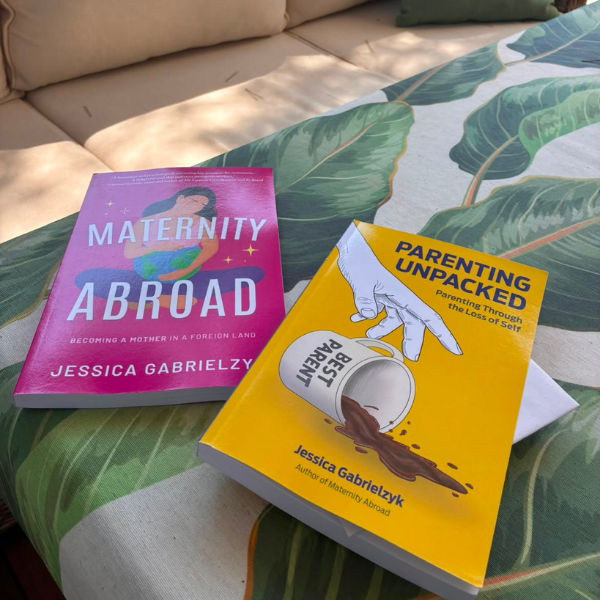
If you are living the part nobody photographs, the loneliness, the loss of felt competence, the child who needs you while you are still learning the rules, Maternity Abroad and Parenting Unpacked are the books written for that search. They do not promise that another country will save you. They give language to what happens after you arrive.
What promise did you think you were moving toward? Reply in the comments below or email hello@jessicagabrielzyk.com.
Jessica Gabrielzyk
Frequently Asked Questions
Why do people move abroad?
People move abroad for many reasons including work, education, relationships, family, safety, political circumstances, lifestyle, and economic opportunity. For some people, moving abroad is also an attempt to find a version of a secure or meaningful life that feels harder to achieve where they currently live.
Why do people romanticise life abroad?
People can romanticise life abroad when another country becomes more than a geographical destination and starts representing the possibility of a better life. Social media can reinforce this by presenting highly selective and positive images of migrants' experiences. Research involving Senegalese respondents found an association between greater exposure to migrants' social media content and stronger migration aspirations.
Is life abroad actually better?
Sometimes it is. Moving abroad can genuinely improve someone's circumstances depending on their work, housing, family situation, safety, education, and access to community. But no country is universally better and migration can introduce new challenges including loneliness, bureaucracy, financial pressure, and cultural adjustment.
Does moving abroad solve unhappiness?
Moving abroad can change the circumstances contributing to unhappiness but it cannot guarantee happiness. Migrants also bring their expectations, identities, and ideas about success with them. Sometimes migration changes the problem and sometimes it reveals that the problem was partly the expectations themselves.
What does the good life mean?
The good life has no universal definition. It can involve financial security, meaningful work, family, freedom, community, belonging, health, time, and purpose. One of the questions raised by migration is whether we have inherited a definition of the good life without ever deciding whether it is actually ours.
Can moving abroad really change your life?
Yes. Migration can profoundly change a person's circumstances, opportunities, and identity. But moving abroad is not a guarantee of a better life. The outcome depends on the person's circumstances, destination, resources, support networks, and expectations.
Sources
Harvard Kennedy School Institute of Politics. (2025). Harvard Youth Poll, 51st Edition — Fall 2025. iop.harvard.edu
Meierrieks, D., & Stier, J. (2025). The Role of Social Media Content in Migration Aspirations: Mixed-Methods Evidence From Two Senegalese Regions. International Migration Review.