I am on vacation. Technically.
Emma is not in school so we are calling it a vacation, which is the parenting version of calling an afternoon nap a wellness practice. It counts. We are going with it.
And while I have many important topics I could be writing about, I also have a lot of thoughts floating around my head and one of them might be slightly controversial. But I had the biggest laugh and I cannot keep it to myself.
I was scrolling on my phone when I came across a video of Matteo Lane and Marcello from SNL joking about how all gay people are Latino and how white people do not help each other. You can click here to watch it.
I thought about it for the rest of the afternoon. Here is where I land on it as a Latina and as an immigrant.
The Latino part? Absolutely. One thousand percent and no notes.
Now the white people comment. I have also met very generous people who were absolutely not Latino. So I do not think it is a general rule. But. Some cultures do have genuinely different ideas about responsibility, relationships, and what we owe each other. And some of those differences are real enough that researchers have given them names.
The one that applies here is familismo.

Was looking for a photo of Carmen Miranda and stumbled across this one. What an absolute queen—she sets the whole vibe for this post! 👑
Familismo is a well-researched cultural value in Latino and Latin American communities. Researchers describe it as a strong sense of loyalty, reciprocity, responsibility, and emotional connection within family and close social networks. It is not simply about loving your relatives. It is about the idea that relationships come with responsibilities. That people show up. That support is something you give and receive without keeping a precise tally of who owes whom what.
I grew up in this. The cousin who knew someone who could fix the thing. The neighbour who brought food when something went wrong. The friend of a friend who had the number you needed before you knew you needed it. It was simply how things worked.
And then I moved abroad and discovered something interesting.
Immigrants do this too.
When you move somewhere new and the system does not know your name, your language, your cultural references, or the things that feel obvious back home, you look for people who understand what that feels like. And you help each other. Because you remember what it was like not to know.
You remember trying to figure out which bin was for which rubbish. You remember not knowing which doctor to call, which form to fill out first, or where to find the food that tastes like home. And when someone else arrives after you, you pass that knowledge along because someone passed it to you and you have not forgotten the specific relief of that moment.
Someone tells you which neighbourhood works for families, or recommends a doctor who speaks your language. That knowledge becomes its own kind of currency and the exchange rate is extremely generous.
Research on immigrant communities consistently highlights the importance of these informal networks. They are not just emotional support. They are practical infrastructure. They help people find their footing in a place that did not come with instructions.
So was Matteo Lane making a sweeping generalisation for comedy? Yes. Was it funny? Also yes. Did it land because there was something underneath the joke that felt genuinely familiar? Absolutely.
I am a Brazilian immigrant raising a child in Switzerland. I have experienced this kind of support from people who had no obligation to help me. I have also been the person passing information along to someone who just arrived because I remember what it felt like when someone did it for me.
The video made me laugh. The research made me think. The combination made me want to write about it on my vacation while Emma is napping and I am technically supposed to be relaxing.
This is what relaxing looks like for me apparently. I have accepted this about myself.
Jessica Gabrielzyk
Further Reading
Sabogal, F., Marín, G., Otero-Sabogal, R., Marín, B. V., & Perez-Stable, E. J. (1987). Hispanic Familism and Acculturation: What Changes and What Doesn’t? Hispanic Journal of Behavioral Sciences, 9(4), 397–412.
Campos, B., Ullman, J. B., Aguilera, A., & Dunkel Schetter, C. (2014). Familism and psychological health: The intervening role of closeness and social support. Cultural Diversity and Ethnic Minority Psychology, 20(2), 191–201.
Portes, A., & Sensenbrenner, J. (1993). Embeddedness and Immigration: Notes on the Social Determinants of Economic Action. American Journal of Sociology, 98(6), 1320–1350.
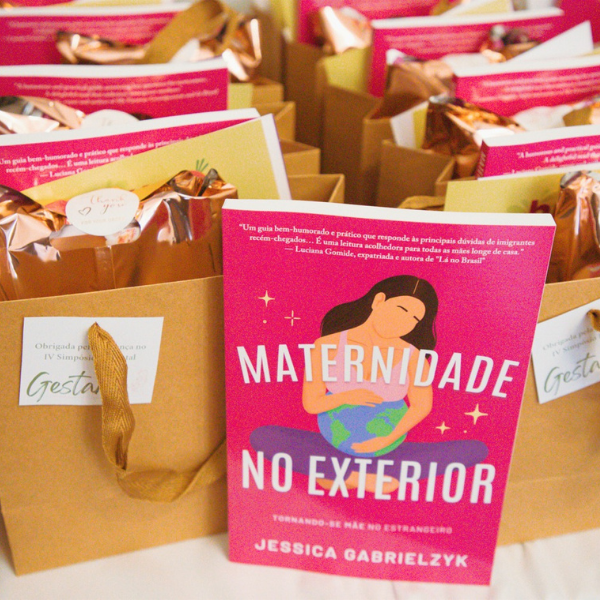
Doing all of this research made me think back to the IV Perinatal Symposium in Dublin, where Maternity Abroad was featured. The event was designed to empower moms-to-be through their first postpartum weeks, brought together by an amazing team: a local expat doula, pelvic floor physio, lactation consultant, and perinatal psychologist.
Moments like that remind me why creating supportive spaces and resources for expat mothers matters so much. What a community to be a part of!