Birthdays Are the Worst. There. I Said It.
In Brazil, or at least in my family, you do not wish someone happy birthday before the actual day. You just do not. It is bad luck. Something terrible will happen. The superstition is very confident about the consequence and completely vague about the details, which is honestly the most Brazilian thing about it.
So I grew up never wishing anyone happy birthday in advance. Not the day before. Not the morning of if it felt too early. On the day. Exactly on the day. That was the rule.
The problem is that I have the memory of a goldfish that has been through a lot.
I forget birthdays. I forget them spectacularly, in the way that makes people check if I am okay, then check if they did something wrong, then go through all five stages of grief before landing on anger. I have forgotten birthdays of people I love deeply, people I think about regularly, people whose faces I can picture perfectly while simultaneously having absolutely no idea when their birthday is.
I forgot a family member’s birthday once. The fallout lasted longer than some international conflicts.
I forgot a childhood friend’s birthday. Years of friendship, gone, because I did not call on the specific day that she arrived on this earth, which I had no system for remembering because I was raised to believe that acknowledging it in advance would bring catastrophe upon her.
She should not feel that special, by the way. I forget everyone.
The anxiety I carry about this is genuinely not proportional to the situation. Ruth Van Reken mentioned her birthday is coming up and I immediately felt my heart rate increase. Tomorrow is my dad’s birthday. I have known my dad my entire life. He was there at my birth, technically the person most responsible for the existence of my birthday, and I am sitting here anxious about whether I will remember to call him.
The superstition means I cannot set a reminder three days in advance because that would be wishing it early in my brain even though the reminder is just a reminder. The logic here is airtight. Do not @ me.
Here is what I have figured out after decades of lost friendships, family drama, and one very uncomfortable conversation with someone whose birthday I forgot twice in a row. The Brazilian birthday superstition was designed with love. It was designed to protect the people you care about from bad luck. What it did not account for is that I would move to four other countries where nobody has this superstition, where wishing someone happy birthday three days early is completely normal and in fact considered thoughtful, and where forgetting the day entirely is read as I do not care about you rather than I was trying to protect you from unspecified cosmic consequences.
I absorbed a rule before I was old enough to question it. I carried it into every relationship I have had since. The rule was designed to show love and it keeps looking like indifference.
This is, I have come to understand, a very small and extremely birthday-shaped version of the inherited scorecard.
Happy birthday to everyone whose birthday is today. If your birthday is tomorrow, I cannot help you. You are on your own until midnight.
Jessica Gabrielzyk
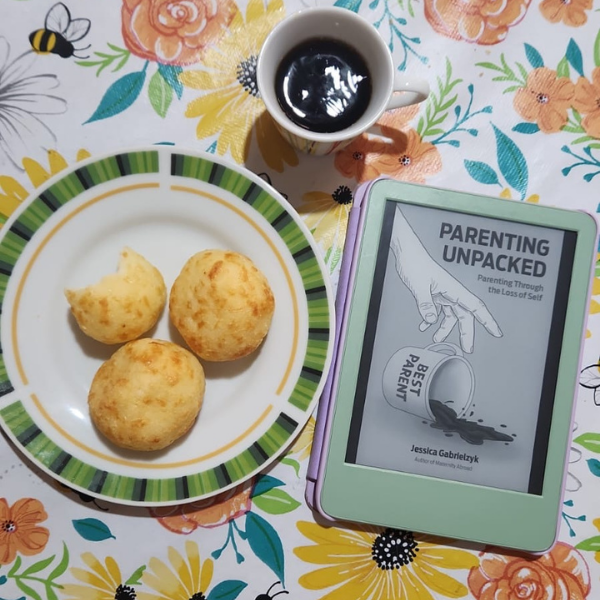
The irony! It’s not my birthday yet, but getting a photo from a reader feels like a gift. An even better gift? When they construct a whole photoshoot scene to match the cover art. ☕️
(P.S. She substituted dark soda for the coffee in the cup because she’d already hit her caffeine quota for the day—safety first!)