Feeling Lost as a Parent Is Still a Taboo. Let’s Talk About It.
Two in three mothers, saying nothing.
That is not a niche statistic. That is the majority of mothers not recognising themselves while making school lunches and attending parent-teacher meetings and answering “fine” when someone asks how they are doing.
And it does not stop with new mothers. Any major change in the family’s life has a way of dismantling the parent’s sense of self, at any age, at any stage. A move to a new country. A job loss. A divorce. The family that reorganised itself around a move or a loss or a child who needed more than you knew how to give. The parent who held everything together through all of it and somewhere in the middle stopped recognising herself.
This is the taboo nobody names. Not the crisis version that comes with a diagnosis and a treatment plan. The ordinary version. The one where you are still functioning, still making the school runs and keeping it together from the outside, while the inside has been off for longer than you want to admit.
There is a name for what that feels like. The loss of felt competence. Not the loss of ability but the loss of the feeling of it. The invisible layer of knowing that used to tell you who you were and what to do next, rebuilt over years of living in a context that knew you, that gave you feedback you could read, that surrounded you with people who already knew your story. When the context changes, the layer disappears. And you are left doing the same things you have always done and getting different results and not knowing why.

Underneath that is what I call the inherited scorecard. The sense that you are being measured against a version of yourself that no longer exists, by standards you absorbed before you were old enough to question them, in a life that has since changed shape entirely. A different country. Before children. Before the family reorganised itself into something you are still learning to recognise. The scorecard keeps running even when the game has changed.
These two experiences together, the loss of felt competence and the inherited scorecard, are what identity migration looks like from the inside. The process of becoming someone different in a context that was not built for you, without being given a word for what is happening while it is happening.
Most resources tell you to seek help, practice self-care, build community, give yourself grace. All of that is true and none of it names what is actually happening. Naming it is the first thing. Not fixing it or rushing through it, just having a word for the specific experience of being competent and not feeling it, of functioning while something underneath the functioning has stopped working the way it used to.
Parenting Unpacked was written for that moment. Not for the parent who came out the other side and wants to share the map. For the parent who is still inside it, getting through the day, reading between the tomatoes and the avocado and putting the book down when the onions need chopping.
The book is not a self-help guide. It does not promise transformation. It promises recognition. And recognition is the more honest promise, because transformation is something you do yourself over time and no book can do it for you. But a book can give you the word for the thing you have been living. And sometimes the word is the beginning of everything.
If you noticed the gap, this book is for you.
Jessica Gabrielzyk
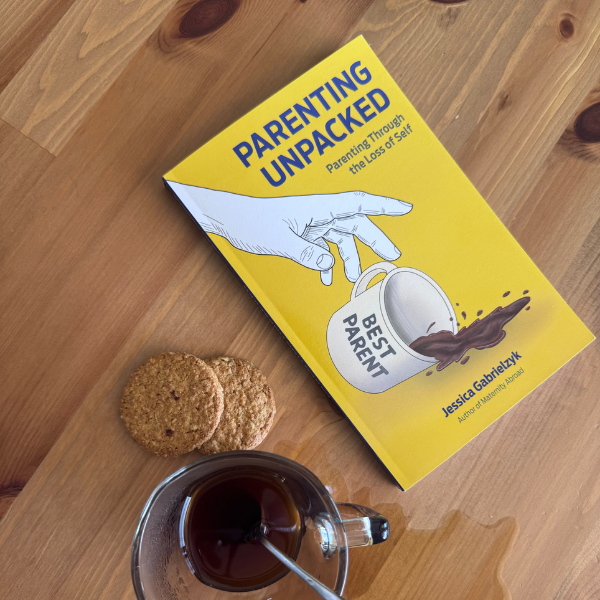
The book is here when you are ready. 💛