I did not tell many people I was going to move abroad.
My brother knew, and some family members, but my friends, the people I saw every week, the ones I thought would be the first to know, most of them did not hear it from me.
I was hiding or anything. But because that is how I work. I build the thing first and tell people when it exists.
So when I moved, she found out the way people find out things you did not announce, after the fact, through someone else, through the absence of me at the places I used to be.
We were close. Good friends from back in the day. And when I came back to Brazil years later we were talking and she said: I thought you had been trafficked.
I want to be clear. There was a Brazilian telenovela about human trafficking at the time. I understood completely why her brain went there. I had disappeared to another country without explanation. She had no context because I had not given her any. I do not blame her for a single second.
But I also could not stop laughing.
Because in my head, while she was apparently imagining the worst, I was learning a language. Going to university. Building something from scratch in a country that did not know my name yet. Quietly and determinedly. With the specific stubbornness of someone who had decided and was not going to unmake the decision by talking about it too much before it was real.
My mom believed I would come back. I think she knew on some level that I would not, not really, not in the way people come back when they never really left. But she held the belief anyway because that is what mothers do.
I knew I would not come back, not because I did not love what I was leaving, but because I had decided to keep going. And I have kept going. I am still keeping going.
This is how I work with everything. The move, the books, the ideas that feel too important to expose before they have any weight behind them. Not superstition or secrecy. Just the knowledge that a thing half-built cannot defend itself against the doubt of people who love you and are scared for you and are watching a telenovela about human trafficking and connecting dots that were never meant to be connected.
I wait, I build, and I tell people when it exists.
The book is the same. Some people knew I was writing it and most did not, and I was working, working, working. And then one day it existed and I told everyone and some of them were surprised and some of them were not and all of them were kind.
The friend from back in the day and I are not close anymore. That happens too. You move, life moves, and some friendships do not survive the distance even when you do. But somewhere out there she knows the truth now. No trafficking. Just one very dramatic telenovela and a Brazilian woman who had already decided.
Jessica Gabrielzyk
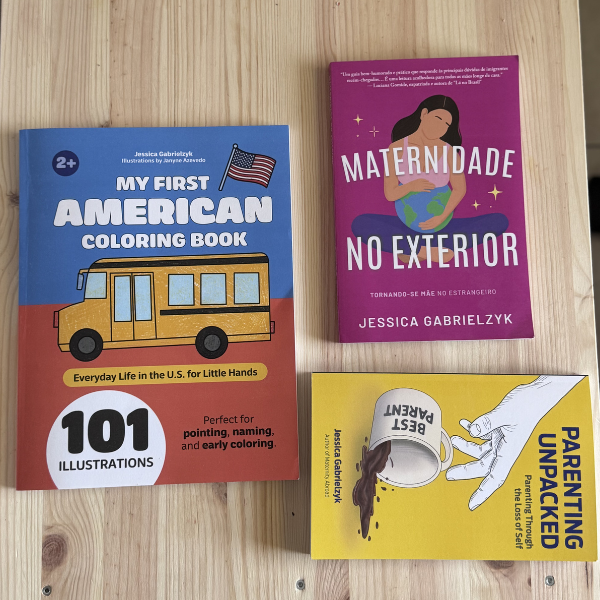
No trafficking. Just books. Maternity Abroad — Parenting Unpacked — My First American Coloring Book. Available now on Amazon worldwide. 💛